There are moments in life when choosing a course is not simply about adding another qualification to a CV. Sometimes, it is about changing direction completely. For many people, aviation represents exactly that: a professional path that feels ambitious, technical, international and full of purpose. In recent years, Spain has become an increasingly appealing destination for those considering Flight Training Spain, particularly for students who want to combine European-standard aviation training with the experience of living in one of the most attractive countries in southern Europe.
Becoming a pilot is not an ordinary career choice. It requires discipline, commitment, financial planning and a genuine interest in learning. But it also offers something that few professions can match: the possibility of working in a global industry, travelling across countries and developing a skill set that is respected all over the world.
For students from the UK and other international backgrounds, Spain can offer an interesting balance. It is close enough to feel accessible, but different enough to provide a real international experience. It has a strong aviation infrastructure, a favourable climate in many regions and a lifestyle that makes the training journey feel more inspiring. …
You have a 300-day streak on your language app. You watch shows in your target language most evenings. You’ve worked through grammar books and saved hundreds of words. And yet, when a real conversation starts, you freeze.
If that sounds familiar, you’re not lazy and you’re not bad at languages. You’re doing what almost everyone does: confusing activity with progress. I built my recent webinar, How to Learn Languages More Effectively, around fixing exactly that — and this post walks through the core ideas so you can start applying them today.
The reframe: your brain acquires a language, it doesn’t “study” it
Most adult language study is passive. We read, we listen, we nod along, we re-read the notes that already feel familiar. It feels productive — and that feeling is the trap. Scrolling an app or rereading a grammar table gives you the satisfying sense that you’re working hard, but feeling productive is not the same as improving.
Cultural differences are well-recognised: every country does things slightly differently, although they may have similarities with others around the world. These differences don’t just stop at eating habits, beliefs, dress codes or family dynamics – they extend out of the home into the world of work too.
In this blog post, we explore the fascinating subject of how interview techniques differ around the globe.
Skills and competencies vs motivations and values
In Western culture, there is a large emphasis on skills and competencies when it comes to interviews. From a practical perspective, this makes sense – your potential employer needs to be confident that you can do the job. Relying on a CV won’t be enough; the interviewer will want to know details about when you’ve put the skills you’ve listed into action.
However, having the right experience and qualifications doesn’t necessarily mean that you’re the best fit for the company. In the Eastern hemisphere, there’s a greater focus on letting the qualifications speak for themselves, and taking the interview time to get to know the candidate. The conversation is more likely to focus on motivations and values, to make sure that the applicant will be a good holistic fit for the team.
During work, we join meetings (even online) and do presentations to many people. You might know every single detail about your subject, but do you really know how to transfer them to the listeners? Are you master of managing your stress and anxiety? We know this is not easy but we can guarantee you, it’ll be easier after taking one of our courses.
Personal development is a lifelong process in one’s lifetime as it is an everyday struggle with ourselves that does not end when traditional education ends. This is actually the whole point of this process: the fulfilment of our personal potential, transforming day by day, to be a better version of ourselves.
Personal development cannot be easily defined as it involves a lot of things like self-awareness,self-esteem as well as a lot of soft skills like the ability to communicate your feelings and goals effectively. Those traits can have a very positive impact on both one’s personal and professional life and can enable one to build strong relationships.
There are, however, some simple steps in order to manage your personal growth.
Hola People is approaching its 5th year of age. Either if you have been following us since our early years, or you knew recently about this brand, you may be curious about how all this started.
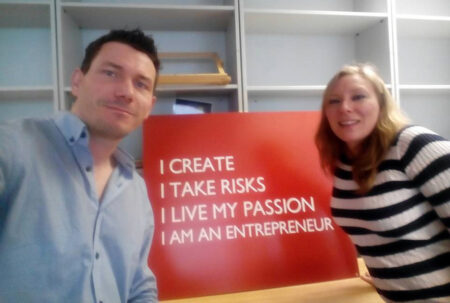
We then must go back to the beginning of 2016, when Elena and Esteban Tejedor, two siblings from Madrid (Spain), headed to Liverpool to take part in a programme for entrepreneurs organised by the Liverpool & Sefton Chambers of Commerce.
After an application and an interview, they were successfully admitted along with several other young entrepreneurs.
Since 2009, Elena (the oldest of both) had already been managing —tirelessly and eventually successfully— her Spanish company called Aula inglés. Aula inglés helps Spanish speaking people to learn English (both in-person and online) and to travel and work abroad.
Esteban, in the meantime and during the previous years, had had a stimulant digital nomad life all around Southeast Asia, and had recently decided to take another step in his life by moving to the UK.
With the valuable support of this entrepreneurial programme in Liverpool, they decided to open a British branch of Aula inglés, doing —so to speak— the other way around, that is to help British and other English speaking people to learn Spanish and to find jobs in Spain.
As local people seemed not to understand what “aula inglés” (English classroom) meant, they had to look for a different name, more suitable for the UK branch. After an intense brainstorming session, Hola People was born.
Soon after, Elena went back to Madrid to keep focusing on her Spanish company, while Esteban remained in Liverpool, owning the British one. To work independently, yet collaboratively, was the best decision… if you have any brothers or sisters, you will know that it is not always easy to agree on things, not to mention managing a business together!
So, Esteban found himself on the mission to make brand-new Hola People grow. Since most British do not show great interest to learn Spanish (fairly speaking, due mainly to lack of necessity), Esteban had to re-adjust the business model. Here is when he started to organise a variety of events in Liverpool, from language exchanges to Salsa classes, Spanish parties, day trips and eventually, personal and professional development courses and workshops. For this last category of events, Esteban created a different brand, QLU Project (QLU stands for Quantum Life University).
By today, Hola People and QLU Project (both brands contained by Atlas & Cosmos Ltd., the official name of the company) have organised hundreds of events, first in Liverpool and currently online, due to the current exceptional circumstances.
Our vision for the future is to be an international reference in the Education sector, not only by teaching languages and personal and professional skills but also providing worldwide travel and work opportunities.
Each of us has our own boundaries and comfort zone. Most of the time it’s really hard to step out of your comfort zone. So, are you stuck in your comfort zone? We asked this question on our Facebook page, let’s have a look the result.
That means 62% think that they stuck in their comfort zone. Comfort zone is the most secure place for people because they are in control and that makes them feel safe. For instance, you know one way to go from work to your home and you always use that way to go because you know everything about that road and it is your secure place. Maybe there are other ways to go; shorter one or with a great view but you don’t know because you always prefer to go in the same way. So, a comfort zone is a beautiful place but nothing ever grows there. Ask a question to yourself, are you really happy or just comfortable?
Hey, it’s Ezgi. Today is time to be aware of negative thoughts which are affecting our life very badly.
Let’s start!
Sometimes even if everything around us is normal but we don’t feel great or thankful because we are willing to see a negative part of life. Maybe we don’t know how to be happy, do we? Being happy is not about money, life quality or other tangible things it is all about how to find happiness inside you and around you. Ah, of course, crying in a Range Rover would be more fun. But we have to start to focus on ourselves.
Do you ever feel like a misfit? Everything inside you is dark and twisted. Whatever you are trying to do but you can’t go forward and so on. I have a solution to your problem then. Your CHAKRAS. Maybe you’ve never heard about this or you know just a little so be ready I am taking you to this magic world of Chakras.
The chakra system originated in India between 1500 and 500 BC in the oldest text called the Vedas. Knowledge of the chakra system was passed down through an oral tradition by the Indo-European people. The Chakra system was traditionally an Eastern philosophy until Western authors started resonating with the idea and wrote about the chakras, expanding upon the older texts and making the knowledge more accessible.
Everybody loves to dance, yet we feel that not everyone is good in performing. Our body automatically responses to rhythm as well to music. All our senses are being tuned in the minute we listen to music, we can feel the way emotions are being expressed. The way the tones are uplifting or down to earth. Bringing in the connection with our emotional body and memories. I know as a kid I was always being struck deep in my heart when the marching bands passed down our streets. At a concert by a band with only a rhythm section, the first song they played opened my heart so wide open, tears started to flow. …
We use cookies to optimise our website and our service.
Functional
Always active
The technical storage or access is strictly necessary for the legitimate purpose of enabling the use of a specific service explicitly requested by the subscriber or user, or for the sole purpose of carrying out the transmission of a communication over an electronic communications network.
Preferences
The technical storage or access is necessary for the legitimate purpose of storing preferences that are not requested by the subscriber or user.
Statistics
The technical storage or access that is used exclusively for statistical purposes.The technical storage or access that is used exclusively for anonymous statistical purposes. Without a subpoena, voluntary compliance on the part of your Internet Service Provider, or additional records from a third party, information stored or retrieved for this purpose alone cannot usually be used to identify you.
Marketing
The technical storage or access is required to create user profiles to send advertising, or to track the user on a website or across several websites for similar marketing purposes.

 Aula ingles





 Since 2009, Elena (the oldest of both) had already been managing —tirelessly and eventually successfully— her Spanish company called